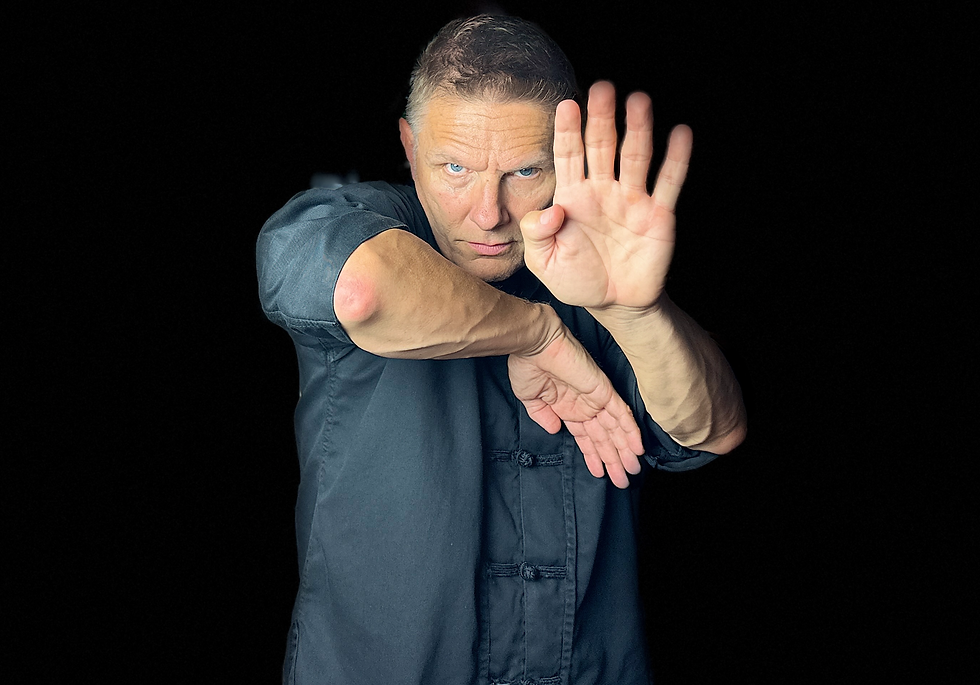
The Best Defense is a GOOD Offense
- Sifu Jason Korol
- Jan 17
- 5 min read
The hyper-aggressive adherents of Wing Chun are correct in that the defense is a good offense. Where they err - and painfully - is in their definition of a good offense. The foolhardy rushing in, throwing chain-punches like one is trying to put out a fire, can certainly be effective…if the opponent is simply overwhelmed. But that’s a dangerous plan. It assumes that there’s nothing the other fellow can or will do other than take his beating at the paws of a superior system.

Here’s the easy way to know if we’re on the wrong path in any application: we give no time or very little to considering the reaction of the other person(s). It’s a common human characteristic that should (repeat: should) be educated out of us by training. Indoctrination and propaganda are not fervent beliefs. Everyone has foundational beliefs and must in order to operate their lives, establish goals, and make decisions. The issue is that if we have no idea of the alternatives, we very likely have no true education.
A Wing Chun fighter does this when they’re quite convinced that their system’s scientific nature is a form of perfection on earth. Granted, they wouldn’t articulate this necessarily due to the obvious insanity of how it sounds, but they’re acting on the belief. This is characterized by the scoffing and mockery of other systems. Of course, we all like to poke a little fun at stuff…that’s not the issue. It’s the wholesale dismissal of all and any truth from other systems that’s the issue. Part of Ip Man’s encouragement to his students to go out and test their classroom training was exactly to counteract this very human temptation. How does Wing Chun interact with Hung Gar or some other Hong Kong system? How will you respond to another fighter playing a different game? Go find out…legally and with relative safety, of course. That was the idea.
Another election season has passed here in America. The pattern we’re discussing in Wing Chun was painfully evident in the field of politics and social philosophy too. Many young people couldn’t tell me anything about the ideas they espoused other than that they were good. It was all emotionalism and sloganeering. When questioned, their reasoning failed very much like a fighter who knows their system but has never had an earnest punch thrown at them. They were immediately blinded by the blow. Worse, they vigorously assumed from the get-go that their political opponent wasn’t merely wrong, but malevolent. When asked what the nature of the other side’s ideas were and why they (the other side) found them to be logical there was no logical reply. Only invective and name-calling.
A fighter who isn’t aware, nor even interested, in what the enemy can/might do is in a very dangerous place. An adult who has no interest in what other people think and why they think it is likewise in danger. Both exhibit signs of intellectual malpractice and having learned through indoctrination. If one is unable and unwilling to test out their theories against all competitors they are not truly educated in their field. Ideas must be testable and actionable in reality in order to be true.
Thus, this whole “good offense” thing is a precarious business when it neglects any concern of the enemy’s response.
To that end, we agree completely that the best form of defense is to get the enemy out of there! We just wish to make sure that we define our terms carefully. A “good” offense is one that subsumes and integrates the defense into the offense. To sacrifice one’s defense for offense is ludicrous in the extreme. Patton is famous for saying that no one ever won a war by dying for his country. You win wars, he reasoned, by making sure the other fella dies for his (and I’m cleaning up the great General’s language). In our case, hit and don’t get hit. Two-in-one. In Wing Chun, lin sui daai da or “simultaneous attack and defense.” Defense is attack and attack is defense.
What Wing Chun does is provide a blistering and powerful attack that very well can overwhelm many an opponent. But in the event that he (the enemy) adjusts, we train to use footwork and shifting, to shut down his attack. Parries and blocks certainly do come in but as an auxiliary of our use of angles and positioning. The plan is simple, logical, brutal, swift, and - not to be overlooked - mobile!
The leading kicks of Wing Chun are brutal low-line (or higher if for some reason that’s necessary and available) bombs that should be used to soften the target before the ground troops (hands) move in. Bomb your way in! The basic kick to the knee or leg is devastatingly simple and should be practiced as much as Muay Thai fighters practice their kicks. With a shoe or boot on, the basic ascending straight kick of Wing Chun is one of the most ruthless attacks at our disposal. To not use them at every chance we get is like a man who plays the lottery and wins but never cashes in. He goes back to his tough job and high bills, living paycheck to paycheck, when he’s, in fact, a millionaire.

Destroy the knees, legs, hips, shins, groin, bladder, and even the ankles of the enemy. Then move in. Move in behind the artillery and air power of those punishing, vicious kicks. Move in only if and when the bombardment has opened up a reasonably safe line of advance. Think of vintage Tyson using his jab going forward. Sloppy Tyson walked forward and loaded up on bombs. Disciplined Tyson was aggressive with the jab and head-movement so that he didn’t get nailed going in, nor tied up easily. It’s very much the same thing here except that we can kick.
If the enemy is able to throw shots at you, get off the line. Use footwork to side-step (the Chum-Kiu Ma) in order to position yourself optimally so as to avoid his attack and set up your own. Repeat as necessary. Obviously, this footwork will need to be practiced repeatedly until it can be done with timing, speed, and balance. Then, go back on the attack with those remorseless leg-killers. If the enemy is off-set, we can certainly blitz him straight-on with the kick and entry. That’s the simplest way to do it. If he’s set, though, or already attacking, move him. If he can’t reach you, or directly face you, your attack has a greater chance of scoring while simultaneously avoiding his. The key is that we must work to both remember this simple goal and put it into action. We don’t brawl! That’s stupid. It’s like a gunfight and we want to get the drop on the guy, not exchange bullet holes! Nail him with those nasty beauties and then move in to finish if necessary (sometimes a dislocated knee-cap is all you need). If you can’t step quickly offline so as to either avoid his attack or simply to offset him. Never attack a set opponent or meet an attack head-on without control. Never sacrifice your defense for your offense. Pound this into your head over and over again because a good offense is only good if it also includes the nullification of his. Trading is a dangerous gambit.
Remember: don’t brawl. Also, you aren’t moving only to get out of the way, but to set up your non-contradictory attack. Make him miss and make him pay.