When Push Comes to Shove
- Sifu Jason Korol
- Mar 4
- 4 min read
When Push Comes to Shove
Most people see Wing Chun as an art dominated by the ubiquitous chain punch and chi-sao practice – at least when you judge by YouTube videos. Though these things are important, they are certainly not the entirety of the system, but aspects of it. Because of their appeal, it’s unfortunate that they tend to dominate the Wing Chun fighter’s training time and this is a gross error in understanding and application.
In fact, Wing Chun is a very multi-faceted methodology that encompasses not just hand techniques and chi-sao, but footwork, pivoting and shifting, pushing, pulling and kicking as well. All of these aspects are important in fighting, which is why all need to be trained equally. Too much emphasis on chain punching and chi-sao, at the expense of these other critical aspects, makes a Wing Chun student very one-dimensional and rather unfit for all-out fighting.
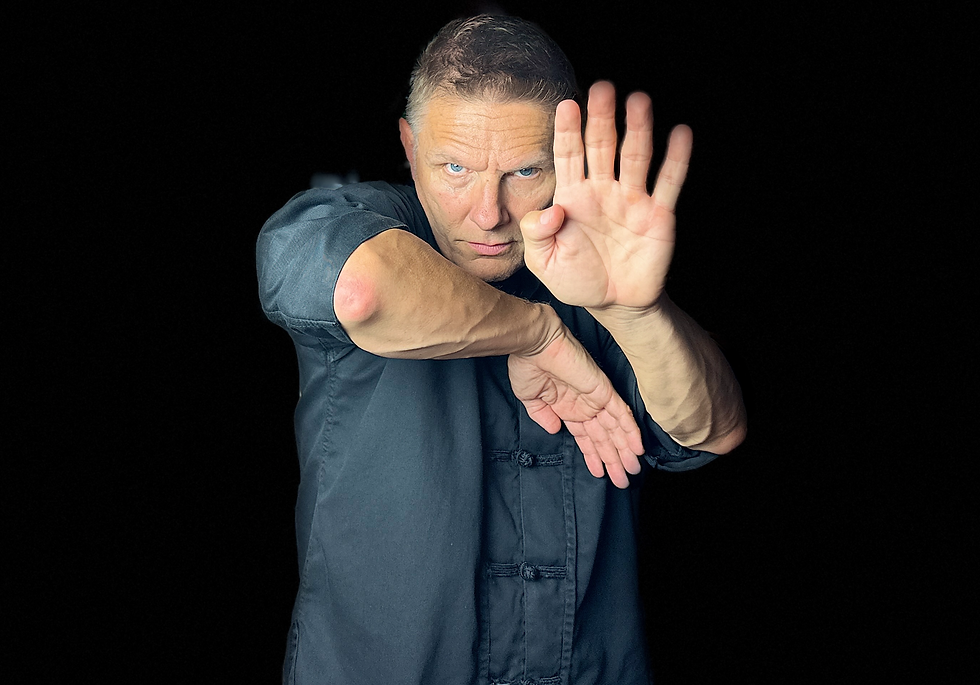
Surprisingly, pushing and pulling are, in reality, of far more use in fighting than other Wing Chun techniques. Why is this? Simply because the vast majority of people are quite tense. Wing Chun fighters are trained to use “springy” power and to dissolve incoming pressure rather than fight it head-on. This is a very difficult thing to achieve – relaxation under pressure – and few fighters ever achieve a high level of it (which is one of the critical things chi-sao teaches and develops). But many fighters have never developed this and, therefore, when there is contact with the opponent they are stiff and tense. The Wing Chun fighter can easily use this against the opponent by means of pushing and pulling.
Imagine, as an example, that the Wing Chun fighter has thrown a quick burst of punches and the opponent throws his arms up to defend himself. His arms are likely to be very tense. At this point, the Wing Chun fighter can use subtle angling and gain control of one of the defender’s arms. The stiffened arm acts as a handle for the rest of the body and the defender can now be driven into nearby obstacles (walls, counters, etc.) and/or pulled off balance. In real fighting there are usually a great many obstacles about that can prove harmful to the combatants. In fact, the greatest fight injuries are usually incurred when one of the fighters strikes his head on a fixed object. This is one of the great benefits of proper Wing Chun training – short, rapid footwork designed for use in cluttered, uneven environments and pushing, pulling tactics that take advantage of that environment. Pushing and pulling are direct results of the Wing Chun fighter having superior position via the use of technically precise steps, shifts, and pivots.
Don’t misunderstand, the Wing Chun vertical punch is a tremendously simple and effective weapon and should be deployed at every opportunity. But nothing exists in a vacuum and the opponent will simply not stand still and get mowed down by a straight blast. More than likely, he’ll pull his head violently back, duck, or throw his arms forward in defense. In every case, pushing and pulling follow-ups work nicely. And since Wing Chun teaches the student to do these with footwork, once the advantage has been gained, it’s very hard for the defender to turn the tables, if not momentarily impossible. And we do well to remember that we don’t need to be superior in every way to our attacker; we merely need to be temporarily superior in position in order to prevail.
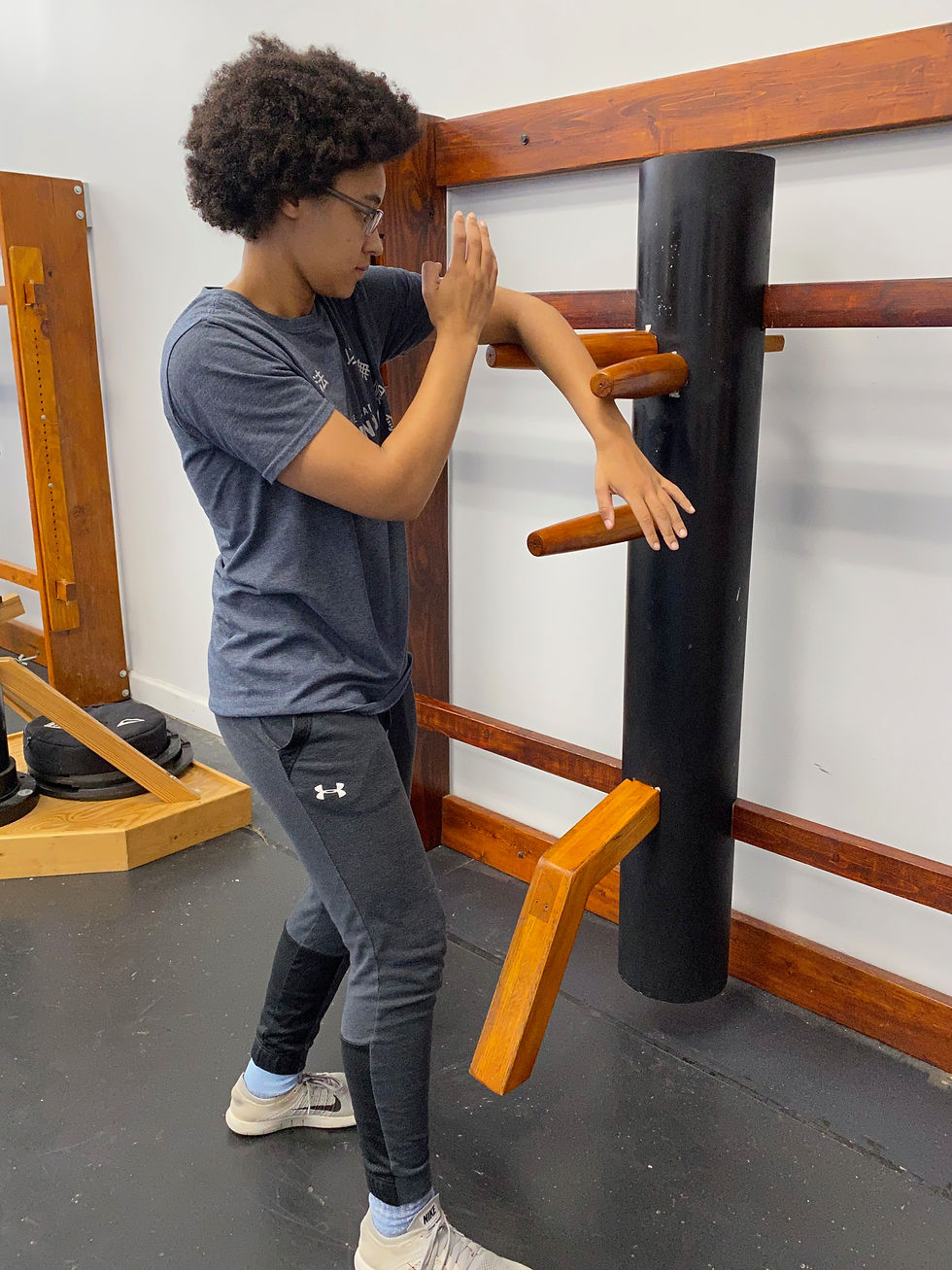
If the defender were to duck or move his head backwards, the Wing Chun fighter can take advantage of his foe’s broken balance and push him into a nearby obstacle while also maintaining pursuit, able to switch directions with a pulling motion like lop-sao should it be needed. Low kicks work quite well in such instances too. Imagine section one of the Mook Jong form, after pressing forward with a tan-sao and a palm push to the head or chin and pinning the enemy into a wall. At this point, a hard, driving low kick would be quite damaging to the enemy’s knee, shin, ankle or foot.
We make a great error by only training parts of the system rather than the whole of it. Moreover, many also focus their training tactics on use against their classmates rather than against the types of opponents likely to be encountered in a real fight. Therefore, they become experts in dealing with centerline-based attacks and opponents that stand erect (with Wing Chun posture and facing). But non-Wing Chun fighters almost never fight like this so many things we can do against them are not trained enough, if at all. Worse still, we run the risk of becoming experts at fighting a style of fight that will actually leave us vulnerable against the MMA/boxing/street-fighting styles we are likely to face in real life. It’s absolutely critical, therefore, to understand and train the whole system and to do so in a realistic yet safe manner.
So, work hard on your footwork and straight punching for these are the bread-and-butter of our method, but also work on the pushing and pulling techniques that are often available as a result of the former. The goal is, as someone once said, to be like water – both physically and tactically.