Wing Chun Footwork: the Problem & Answer
- Sifu Jason Korol
- Feb 17
- 5 min read
Wing Chun is a comprehensive system of simplicity.
That’s a simple sentence but a profound truth that takes a lifetime to wrap one’s head around. Simple and comprehensive? Yes.
Siu Lim Tao and Chum Kiu concepts dominate the hierarchy of application principles. What we mean by this is that in Wing Chun we seek to do the simplest thing first and the early forms - and the first movements of those forms - generally provide the roadmap to self-defense success. If a bloke is rearing back to punch us, the idea isn’t to do something fancy but to intercept him with an attack of our own. It’s better to give than receive, after all. Punch him in the nose. Or hit him in the eye. Or kick him in the knee.
Simple.
But not easy.
But what happens if we’re unable to achieve this out of the gate? Then what? Well, the system has a set of principles to guide us. Within Wing Chun this is called “recovery” and that means any movement or action taken because the simplest action - the interception or simultaneous attack and defense - was unavailable for whatever reason. And remember, we live in the real world and not the perfect one of our imaginations. Maybe we were simply unprepared. Or the enemy was quick on the attack. Whatever the reason, what counts is reality and not our preferences. I’d prefer to be getting younger. I’d prefer have more money and less traffic, but the opposite is usually in order. The key is always and forever our ability to keep sight of the main thing while having a realistic plan of achieving it. Wing Chun, being a logical combat systematic, does precisely this.
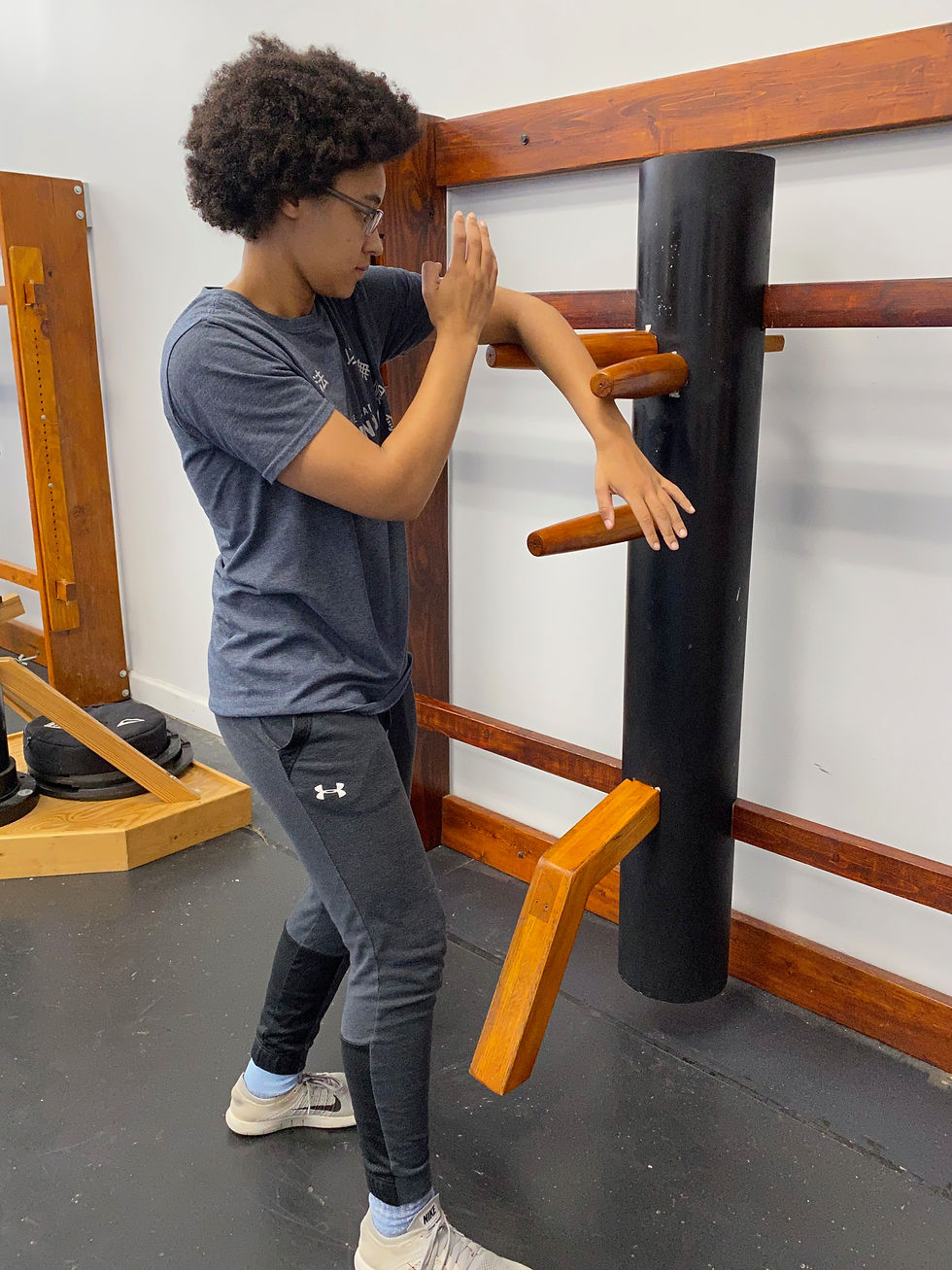
In most families the Mook Jong form is taught after Chum Kiu because the first section of the dummy presents the idea of recovery. Without getting too detailed and making this a 10,000 word essay on the Mook Yan Jong’s first section, we simply bring your attention to the bong-sao action in the dummy’s opening section. It’s considered to be “wrong” bong-sao not because we’re supposed to apply the technique improperly but because we’re to imagine that the angle is wrong. The thought is that we’ve executed a technique (not to be limited to the bong-sao) but found ourselves in a less than optimal position. In this case we’re facing the dude’s other hand and lined up for a wallop.
Hence, “wrong” bong-sao. We’re on the inside gate without positional control. This presents the first systematic answer in Wing Chun to such difficulty. Again, to be clear: the concept expressed/taught in this situation is the Wing Chun defender has found themselves out of position. Why? The best answer to that query is the obvious one: we’re in a fight and things don’t go along perfectly in fights. To think otherwise is a surefire way to get KO’d.
The answer presented to this problem - the recovery - is not a move but to literally move. In other words, footwork.
The lateral step allows the Wing Chun exponent to “get off the line” and out of harm’s way. This is a truly significant truth hiding in plain sight. The hand techniques in Wing Chun are often trained at the expense of footwork. Gaining structural skill in fook-sao and bong-sao, for example, requires that the student stand still. This leads to the erroneous presumption that good Wing Chun is all about the hands, not feet. Not true. It’s an easy mistake and many of us make it; we confuse training drills and educational order for fighting application.
Section one of the Mook Jong should disabuse us of this folly. If a train is barreling toward us it makes a whole lot of sense to get off the tracks. Same thing here. A little footwork prevents a lot of turmoil. There’s something else with this that’s worthy of mention, by the way. When you watch combat sport fighters in their sparring or competition, notice how many little steps they take. The best of them are masters at it so much that you hardly notice the craft. But they’re all doing it in various ways and with differing amounts of skill. It’s positional adjustments and it’s continual throughout the match. This is the primary and foundational difference between boxing/MMA etc. and the so-called traditional methods that causes so many to dismiss out of hand anything but combat sport. The issue isn’t the techniques necessarily but the footwork. Sparring forces people to move and make constant adjustments of range and angle.
Once you know to look for this it will change the way you see everything thereafter. The slightest adjustment of range and angle will render one thing effective and another void. When we speak of things like timing and accuracy we’re really talking about footwork. The sad thing is that even the most rudimentary MMA student who has been sparring will have better application than an advanced Wing Chun student who has no footwork. It’s not an issue of round kicks and all that being better than straight kicks and chain punches. It’s a matter of position.
The idea on the Mook Jong is to teach the proper mechanics of the side-step and accompanying “Jeet Ma” (Sip Ma) that reengages the line. The educational aspect of the form leads many to falsely believe that the “whole-beat” (timing) footwork is the manner in which Wing Chun is supposed to move all the time. No. That’s just the way the educational system of the forms introduces the trains the mechanical structures. Once the mechanics can be performed with skill the student should begin working on “half-beat” or “irregular timed” footwork. Footwork gets us out of the way of the enemy’s attack and allows us to safely drive home our own. To do this requires both mechanical skill (technique) and adaptability (timing). Wing Chun footwork is, therefore, similar to the combat sport footwork you see all the time in terms of its ability to make constant adjustments, and more logically consistent with the facts of reality insofar as terrain and environment are concerned.
Combat sport systems are indeed “over-daring” by assuming that sparring is a panacea but the realism of timing and distance gained in that activity are not fallacious. Let’s not be emotional about the issue. Not liking MMA doesn’t mean everything they do is contradictory. In this case, the skill of making constant small adjustments of range and angle is something required by combat and, therefore, something to emulate. But we aren’t copying! The Wing Chun footwork is already there and the timing is implied within the system (more on that later). It’s simply a case of Wing Chun students, as we’ve said, making the mistake of thinking the educational order of the forms means that we must move in dead patterns. In truth, Wing Chun footwork is the best system of transportation for the goal of self-defense in the real world of unsure footing and cluttered environments. We simply need to understand this and then train accordingly.