
Wing Chun: the Science of Self-Defense
My Sifu, the abundantly handsome and talented Tony Massengill, told me once that the Wing Chun forms are the structural foundations of applications. But, wait. There’s more. He added that those applications are limited only by your need. Wing Chun, he said, is a system of structures and concepts. It is not, repeat not, a “traditional system” in that it expects blind conformity to a set way of application.
Okay, first, let’s look at what I didn’t say.
This doesn’t mean that there is no structure around which one must conform. To say that is to destroy the system entirely because we live in a physical world with physical bodies. I know…duh! But this means that our body is governed by specific laws anatomically and so on. Obviously, a man isn’t a bird, nor a toaster oven. The Wing Chun forms, therefore, are moving textbooks that teach us “best practices” through which we learn to apply our body in combat for the purpose of self-defense.
Off the top of my head I’d say that a super majority of online disputes regarding Wing Chun center on the misunderstanding of this particular point.
You’ve seen it, I’m sure (insofar as you’re reading this means that you’re a Wing Chun dude or dude-ette). Someone posts a video and then a cauldron of online experts, with talented fingers of doom, feverishly typing away in the dread environments of home, surrounded by imposing dangers so vast as to make even the greatest warrior shrink back, attack the video over some technical issue or another. These brave souls, full of indomitable courage, taking a break from their gaming schedule, stopping only to make sure the Hot Pocket is cooked all the way through, boldly announce that because someone’s Tan Sao is a centimeter this way or that all is lost.
This comic-tragic scene is as sure a bet every day as the sun rising. The lesson to glean from it is simple: too many Wing Chun keyboard crazies are convinced that all of combat is covered in technique. That is to say, structure. Therefore, if they don’t approve of your form, you are the worst. You are less than the dog poo stuck between the toes of a poor schlep that walked through the yard barefoot for whatever reason. Worse than that, you’re probably a bad tipper too. Clearly you’re going to the hot place when you die because how dare you!
The funny thing is, I’m not exaggerating and you know it.
These folks are out there.
The root of the issue is that in all their hubris they have zero intellectual discipline. That is, of course, the very defining characteristic of those who overdose on pride. It just doesn’t dawn on them that good technique is a part of the Wing Chun system and not the whole. It won’t apply itself. Next, the structure needs to be trained. Then it must be applied. Each of these is a field of study by themselves. Again: the forms are the structural foundations of applications. Training drills provide the safe environment in which we take those structural foundations in the forms and develop them so that they become reflexive. Tactics are the study of combat application on diverse battlefields.
Technique.
Training.
Tactics.
The Wing Chun system of forms must be studied, practiced, and understood in the context of training and fighting application. Losing this distinction causes us, as evidenced by the online geniuses, to nearly idolize and worship technique itself. It’s for this reason that Ip Man used to challenge his students to not take his word for something but to go and test it for themselves. Why? Because it’s the individual that has to make the technique work, not the system. Wong Shun Leung is rightly lauded for saying, “don’t be Wing Chun’s slave but, rather, make it your slave.”
Incidentally, we strongly believe that this is precisely why Bruce Lee developed his Jeet Kune Do. The foundation, and we’re speaking philosophically, not merely technically, was Ip Man Wing Chun and the advocacy to make the system his slave. Bruce Lee did what he was encouraged and trained to do, which was use the system and not be used by it. In Lee’s case, he trained assiduously, and with great focus of mind, on stopping an attack at the earliest moment possible. The “jeet” isn’t something foreign to Wing Chun but baked into the cake. The thing Lee did was really zero in on it. Lee sought, and achieved, great simplicity of action by being bold enough to take the basic punch and kick, and apply them at long range. Hawkins Cheung once said that what Lee developed was a distance application of the Wing Chun concept. He called it, “straight punch, side kick, and pak sao.” Obviously, anytime you narrow something down like that you have to leave out some relevant detail, but Hawkins Cheung wasn’t off base with this.
Jeet Kune Do was a product of taking the structural foundations and then studying how to apply them.
Okay…so to that end we say that the structural foundations are integral to Wing Chun application. It’s another mistake on the opposite end to dismiss the forms as no big deal in search of application alone. The very idea of application is, after all, the application of a weapon or tool. Which weapon? Which tool? Wing Chun rewires our circuitry so as to develop a highly sophisticated human weapon. Without the forms there is nothing to apply or drill, so the system collapses. But without the integration of logical drills toward the goal of fighting application the forms are dead in the water.
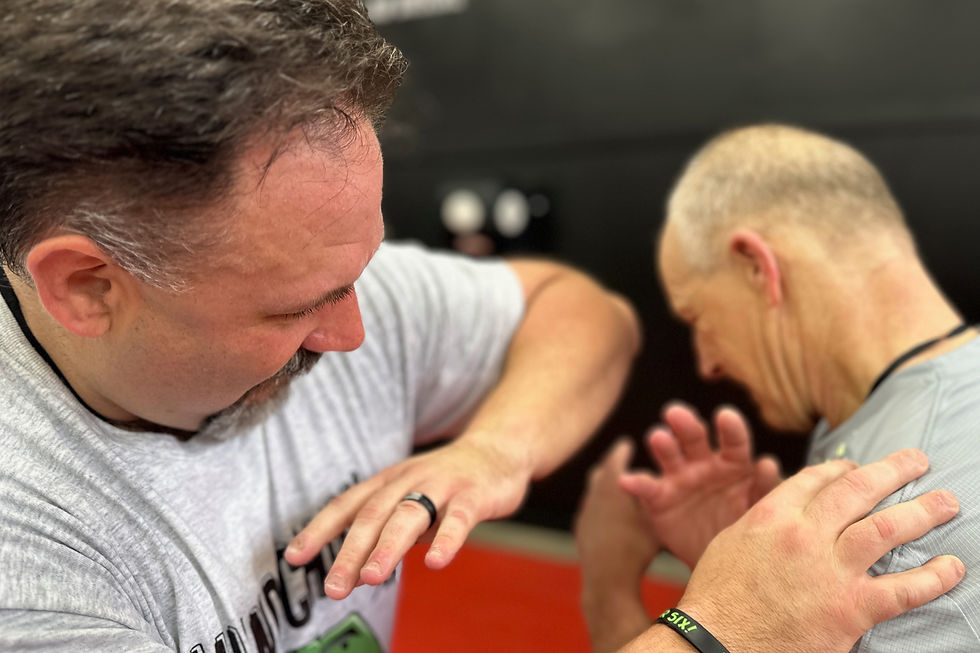
The question of application is simple: to what goal?
If you’re training for a competition, the goal is settled. The techniques you train must be legal in the competition. Training eye gouges when you’re a boxer is a waste of time. Because Wing Chun is preparing for predatory violence, that is, self-defense, there simply are no restrictions on tool usage and targeting. Furthermore, since the goal is self-defense in the event of unavoidable violence one must learn a system that logically prepares, best as it can, for the implications of that fact. Bad terrain. Cluttered surroundings with hard objects like countertops, curbs, chairs, and so on, that are as dangerous as the enemy. Possible weapons and multiple opponents. All of that must be considered and that’s why Wing Chun forms and drills are what they are.
A lack of integrated thinking is what causes the ridiculous online warfare as well as poor quality Wing Chun. If the goal is to win at Chi-Sao, that’s going to impact one’s training and how the forms are approached. If the goal is to win a sparring match or some other type of competition, that will likewise impact the forms’ training downstream of it. For example, the antipathy that MMA fans express toward watching Wing Chun drills or forms is precisely due to their inability to think critically about the issue of the application goal-setting. They simply can’t fathom that a fight won’t take place between two competitive athletes in the prime of their lives in a certain place and time and on a padded floor with a cage. The thought that a 65 year-old man will need a system of defense against a 30 year-old in a grocery store parking lot doesn’t occur to them. In this event, which actually happened to a Wing Chun fighter last year, he thumbed the assailant in the eye. He achieved this quite easily through his training in Wing Chun. Specifically, the Chum Kiu form had that direct action which he used to thumb the guy and his training in Chi-Sao had fine-tuned his reflexes so that it happened instantly, without conscious thought.
Fight over.
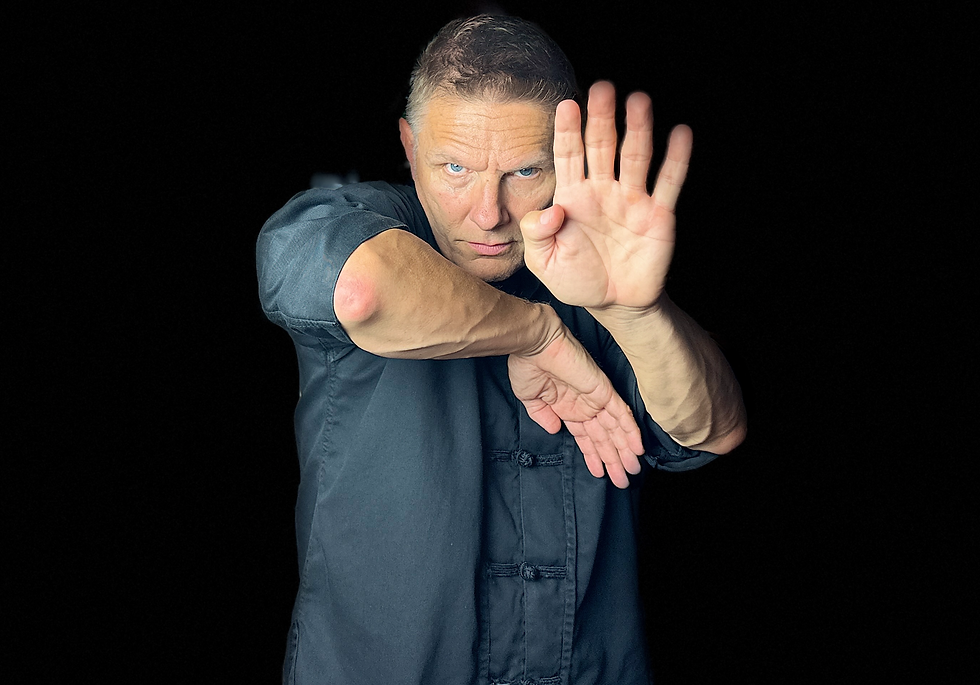
. He needed a simple, but brutal system…without a warm-up…with no weight class considerations or other rules. The thumb to the eye worked perfectly to achieve the goal, which wasn’t to find out who was the better combat athlete. It was about survival. Pure and simple.
And you know what? I’m pretty sure that if the young assailant and the 65 year-old Wing Chun man had a sparring match, the younger man would have won. Thirty-five year age advantages simply are what they are. And this is why Wing Chun is a combat science, not a sport. And that’s why it must be trained logically with an integration of the forms, the drills, and application tactics. Each part is important and contradictions must be rooted out.
